
Rotary vs. Linear vs. Ultrasonic Vibrating Screens: Which Should You Choose?
Choosing the right vibrating screen requires more than comparing machine shapes or screening mesh sizes. Rotary, linear, and ultrasonic screening systems are used for different material-handling challenges, and their suitability depends on particle characteristics, separation requirements, processing conditions, and production objectives.
For industrial buyers, the key question is not simply which vibrating screen is better. It is which screening method is appropriate for the material and the intended process.
This guide explains the differences between rotary, linear, and ultrasonic vibrating screens, their typical applications, the limitations buyers should consider, and the information needed before requesting an equipment quotation.
1. What Is the Difference Between Rotary, Linear, and Ultrasonic Vibrating Screens?
The primary differences involve the screening motion, machine configuration, and how particles interact with the screen surface.
A rotary vibrating screen typically uses a circular screening deck with vibration generated by an eccentric motor arrangement. A linear vibrating screen uses a predominantly linear motion to convey material across the screen surface. Ultrasonic screening introduces high-frequency vibration to the screen mesh to help address certain fine-powder screening problems.
Importantly, ultrasonic screening is not necessarily a separate primary motion type. An ultrasonic system may be integrated with a conventional vibrating sieve, including a rotary screening machine.
Quick Comparison of Vibrating Screen Types
| Comparison Factor | Rotary Vibrating Screen | Linear Vibrating Screen | Ultrasonic Screening System |
|---|---|---|---|
| Main operating principle | Multi-directional vibration in a circular screening assembly | Predominantly linear vibration | High-frequency vibration applied to screen mesh |
| Typical screening duty | Powder and granule classification, oversize removal | Material classification and conveying across a screen | Fine-powder screening assistance |
| Material handling | Circular screen arrangement | Directional movement across the deck | Depends on the underlying screening machine |
| Main consideration | Material flow and screen configuration | Feed distribution and conveying behavior | Mesh blinding and fine-particle behavior |
| Common application areas | Food ingredients, chemicals, industrial powders | Granules, minerals, suitable bulk solids | Fine chemical powders and other difficult-to-screen materials |
| Important limitation | Not every rotary design suits every material or capacity | Performance depends on material and deck design | Ultrasonic assistance does not solve every flowability or moisture problem |
These comparisons describe general industrial screening principles, not guaranteed performance characteristics of a specific machine model.
2. How Does a Rotary Vibrating Screen Work?
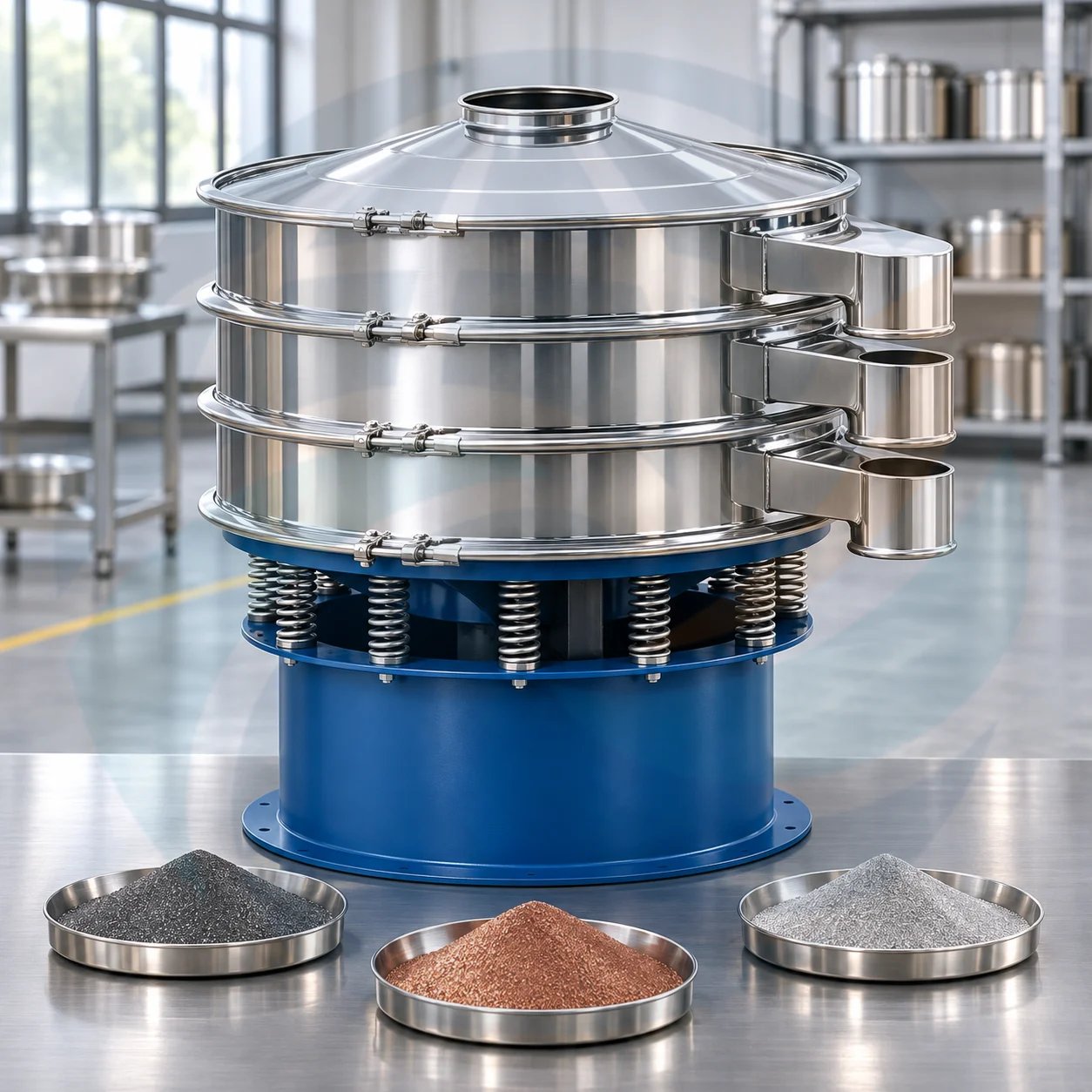
A rotary vibrating screen commonly consists of a circular screening assembly, screen mesh, vibration-generating motor, supporting structure, and material discharge outlets.
Vibration causes the material to move across the screening surface. Particles smaller than the effective screen openings can pass through, while oversized particles are retained and directed toward an appropriate discharge outlet.
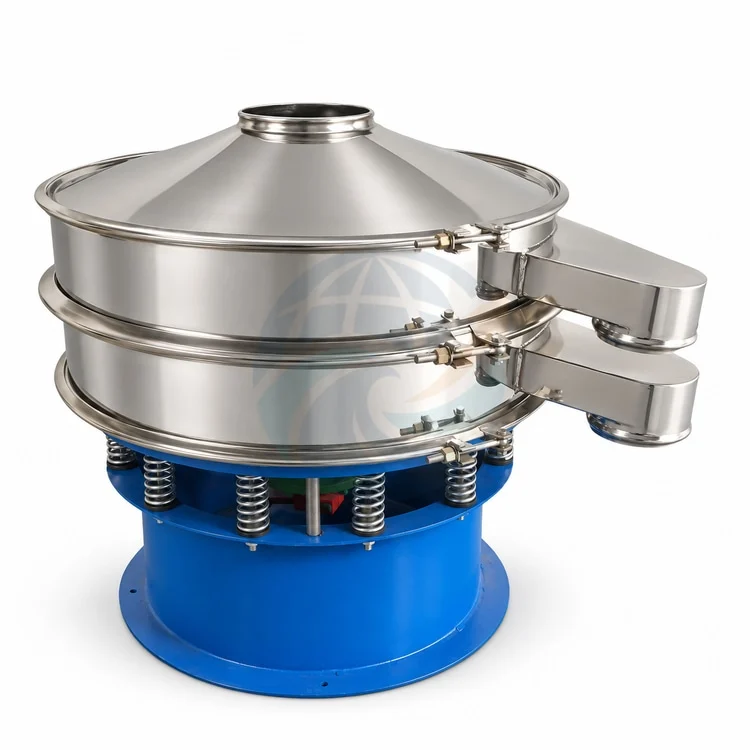
The actual particle movement depends on the machine design, vibration settings, screen configuration, and material properties.
Typical Applications of Rotary Vibrating Screens
Rotary vibrating screens are commonly considered for:
- Screening flour, starch, and other food powders.
- Removing oversized particles from chemical powders.
- Classifying suitable granular industrial materials.
- Separating unwanted agglomerates from powder products.
- Processing materials that require one or more screening stages.
When Should You Consider a Rotary Vibrating Screen?
A rotary vibrating screen may be worth evaluating when the process involves powder or granule separation and a compact circular screening arrangement fits the production layout.
However, selection should consider material flowability, required throughput, screen opening size, cleaning requirements, and the number of product fractions.
For food or sensitive chemical applications, buyers should also verify contact materials, cleaning access, sealing arrangements, and any applicable compliance requirements.
A machine described as stainless steel is not automatically suitable for every food, pharmaceutical, corrosive, or hazardous application.
3. How Does a Linear Vibrating Screen Work?
A linear vibrating screen generates vibration that moves material in a predominantly straight direction across the screening deck.
Depending on the design, vibration can be produced by coordinated exciters or vibration motors. The resulting movement helps transport the material while allowing appropriately sized particles to pass through the screen openings.
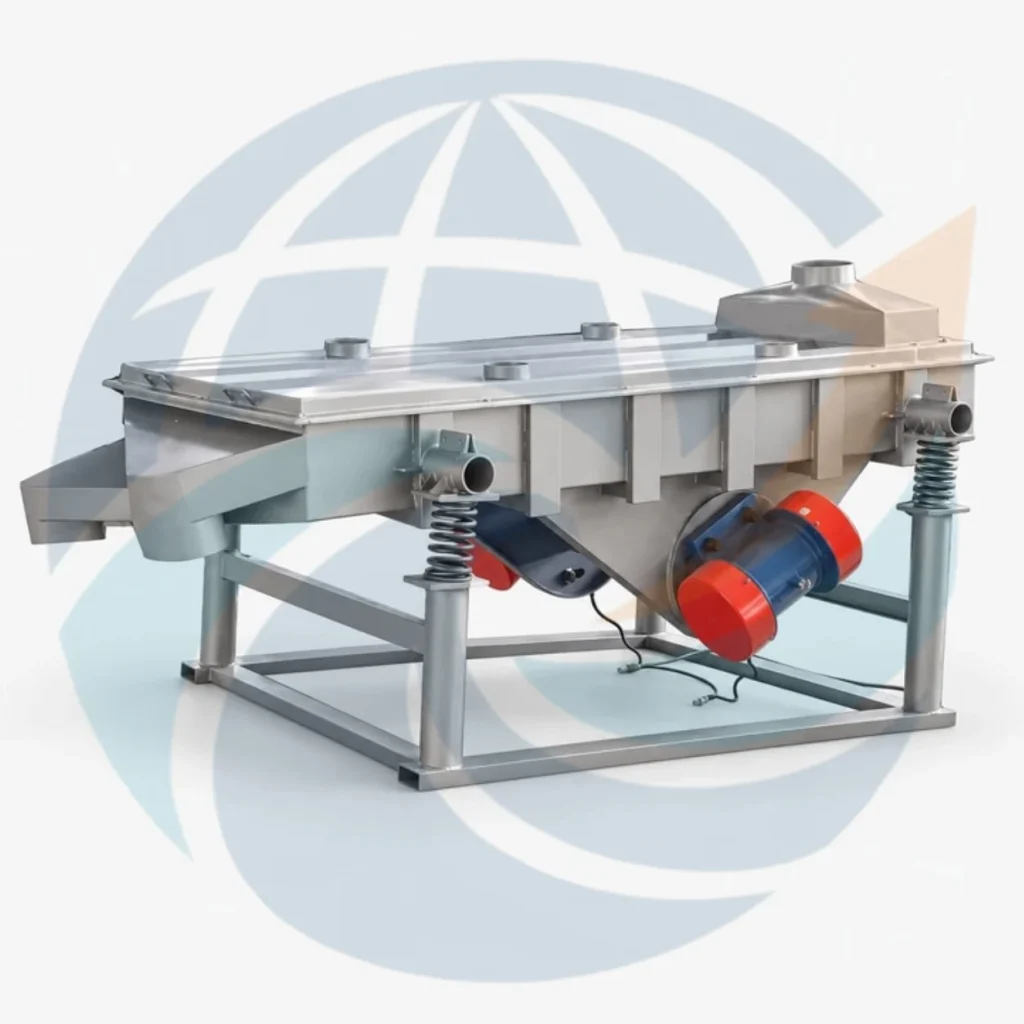
Linear screening equipment is available in different sizes and arrangements, so the suitability of a particular machine depends on the intended process.
Typical Applications of Linear Vibrating Screens
Linear vibrating screens may be considered for:
- Grading suitable dry granular materials.
- Classifying plastic pellets and industrial granules.
- Screening certain mineral and sand products.
- Separating bulk materials into designated size fractions.
- Applications requiring material transport across a screening deck.
When Should You Consider a Linear Vibrating Screen?
A linear screen may be appropriate when the process requires directional material movement and a suitable rectangular screening deck arrangement.
Key selection factors include feed distribution, material characteristics, screening area, target separation size, discharge arrangement, and operating conditions.
For abrasive minerals or aggregates, the machine structure, screen media, wear protection, and actual duty rating must be verified. A light-duty linear screener should not automatically be treated as interchangeable with a heavy-duty aggregate screen.
4. What Is an Ultrasonic Vibrating Screen?
An ultrasonic vibrating screen typically combines conventional screening motion with an ultrasonic system that introduces high-frequency vibration into the screen mesh.
The purpose is to modify how fine particles interact with the mesh and help reduce certain forms of screen blinding.
In powder screening, blinding occurs when particles obstruct screen openings and prevent material from passing through effectively.
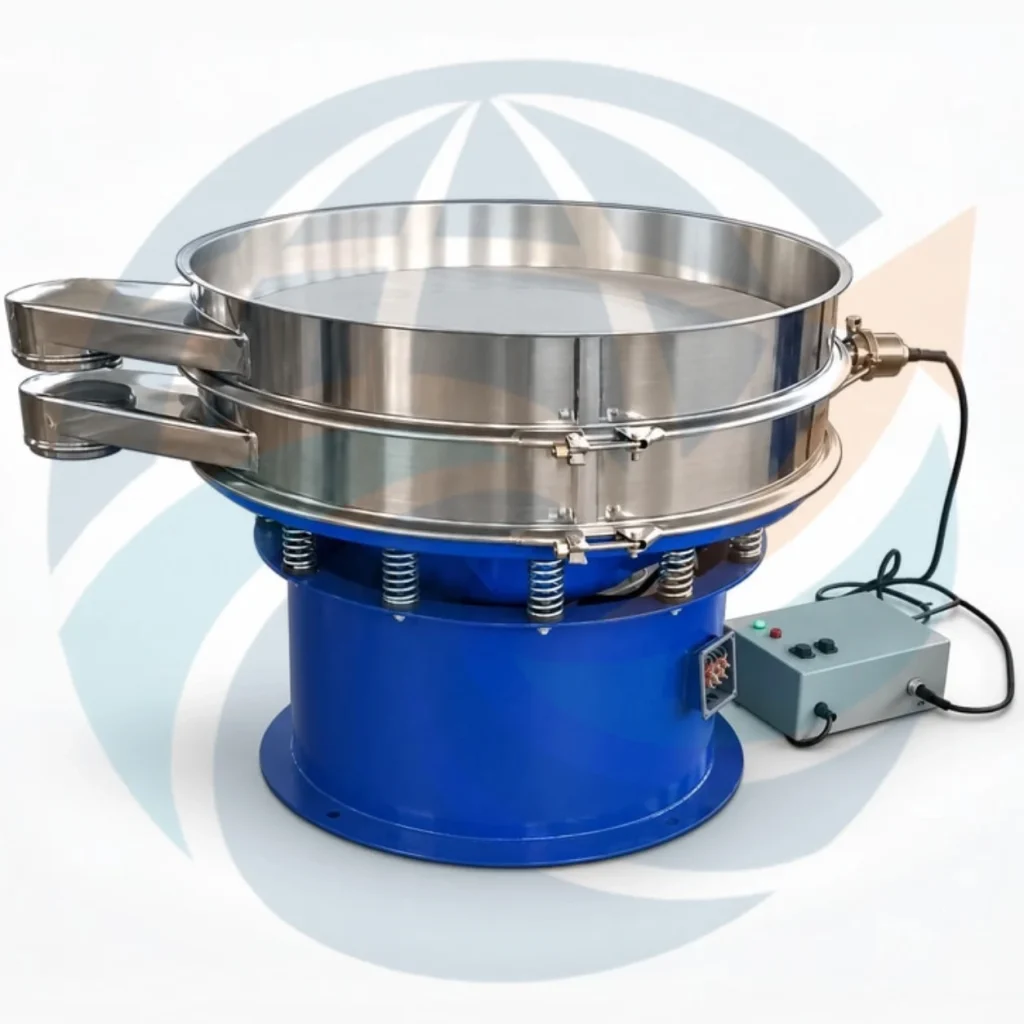
Ultrasonic assistance can be considered when conventional screening struggles with certain fine, cohesive, or electrostatically affected powders.
However, its effectiveness depends on the material, mesh, equipment design, ultrasonic system configuration, and processing conditions.
Typical Applications of Ultrasonic Screening
Potential applications include:
- Fine chemical powder screening.
- Screening certain pigments and powdered additives.
- Processing fine powders that tend to obstruct screen openings.
- Applications where conventional mesh screening produces persistent blinding.
When Is Ultrasonic Screening Worth Considering?
Ultrasonic assistance is worth investigating when ordinary vibration produces excessive mesh blinding and the underlying material and screening conditions are suitable for ultrasonic operation.
It is not automatically the best solution for every fine powder.
High moisture, severe agglomeration, poor bulk flow, unsuitable feed conditions, and incorrect mesh selection may require other process changes.
Before selecting an ultrasonic system, buyers should discuss material samples, target particle size, feed conditions, and testing possibilities with the equipment supplier.
5. Which Vibrating Screen Is Suitable for Your Material?
Material characteristics are often more important than the machine’s general product category.
A suitable screening solution should reflect both the physical properties of the feed and the required separation result.
Food Powders: Flour, Starch, and Sugar
Food powder screening may involve removing oversized material, breaking out acceptable particle fractions, or checking products for unwanted agglomerates.
A rotary vibrating screen may be considered for suitable powder screening duties.
For fine powders that experience mesh blinding, an ultrasonic-assisted configuration may also be worth evaluating.
However, hygienic design, product-contact materials, cleanability, allergen control, and applicable food-contact requirements must be verified for each installation.
Chemical Powders: Pigments and Additives
Chemical powders can vary considerably in particle size, flowability, moisture sensitivity, abrasiveness, and electrostatic behavior.
Rotary or linear equipment may be suitable for different screening duties, while ultrasonic assistance may help with some fine-powder screening challenges.
The chemical properties of the material also matter.
Buyers should identify any corrosive, combustible, toxic, or otherwise hazardous characteristics before choosing equipment. Material compatibility, dust control, grounding, electrical protection, and applicable safety requirements must be assessed separately.
Industrial Granules and Plastic Pellets
For granular materials, selection often depends on required size separation, feed rate, particle shape, and desired discharge arrangement.
A linear vibrating screen may be considered where directional material transport is important.
A rotary vibrating screen may also be appropriate for certain grading or oversize-removal duties.
The final choice should be based on the actual feed material and screening objective rather than a broad industry label.
Minerals, Sand, and Aggregates
Mineral and aggregate applications may involve substantially different operating duties, from screening relatively fine dry materials to processing large quantities of abrasive crushed stone.
Linear screening equipment can be considered for some mineral classification processes, while heavy-duty aggregate applications may require specialized inclined, horizontal, or other mining screen designs.
The equipment must be selected according to the intended duty, not simply because it is labeled a vibrating screen.
For abrasive and high-throughput applications, buyers should verify machine construction, wear protection, screen media, design capacity, and service requirements before purchasing.
6. How Do Material Properties Affect Screen Selection?
Even when two materials have similar average particle sizes, they may behave very differently during screening.
Particle Size Distribution
A screening operation must account for the range of particle sizes entering the machine, not only the nominal size of the final product.
The proportion of near-size particles can affect separation difficulty. Screen aperture size alone cannot determine the performance of the entire system.
Moisture and Agglomeration
Moisture can change how particles flow and interact with the screening surface.
Some materials form clusters or adhere to screen openings, making separation more difficult.
Where moisture causes severe adhesion or agglomeration, changing the screening technology may not be sufficient without addressing the feed condition.
Bulk Density and Feed Rate
Bulk density, mass flow rate, and material distribution influence the loading experienced by a screening machine.
A suitable machine must be evaluated against the required processing duty.
Manufacturers should not assign guaranteed throughput solely from a mesh designation or a general equipment category.
Abrasiveness and Material Compatibility
Abrasive materials can increase wear on screening media and contact components.
Chemical materials may require specific contact materials or protective arrangements.
Food processing may introduce additional cleaning and hygiene requirements.
These factors should be included in the equipment inquiry before a supplier recommends a configuration.
7. Rotary vs. Linear vs. Ultrasonic: How Should You Decide?
Use the following decision process to narrow down the options.
Step 1: Define the Screening Objective
Determine whether you need to:
- Remove oversized particles.
- Classify material into different particle size fractions.
- Screen powders before packaging or further processing.
- Separate acceptable product from unwanted agglomerates.
- Perform another clearly defined screening duty.
Step 2: Identify the Material Properties
Record the material name, particle size distribution, bulk density, moisture condition, and any known handling difficulties.
Indicate whether the material is abrasive, corrosive, combustible, or sensitive to contamination.
Step 3: Compare Appropriate Equipment Arrangements
Consider a rotary vibrating screen for suitable powder and granule screening applications.
Consider a linear vibrating screen where the intended process benefits from directional material movement and an appropriate deck arrangement.
Investigate ultrasonic-assisted screening if fine-powder mesh blinding is a persistent concern.
These are preliminary selection directions, not final equipment specifications.
Step 4: Verify the Required Separation
Identify the target screen opening, required product fractions, acceptable oversize content, and desired screening outcome.
Where available, provide a particle size distribution report or representative material sample.
Step 5: Confirm the Operating Requirements
The selected machine must suit the required feed rate, installation arrangement, electrical supply, maintenance access, and process environment.
Final suitability should be confirmed through technical review and, where appropriate, representative material testing.
8. What Information Should You Send When Requesting a Quotation?
A well-prepared request for quotation helps the supplier evaluate the application rather than recommending equipment from a product photograph alone.
| Required Information | What to Provide |
|---|---|
| Material | Material name and composition, where relevant |
| Particle size | Feed particle size range or distribution |
| Screening objective | Grading, oversize removal, or another separation duty |
| Target separation | Required screen opening or product size specification |
| Capacity | Required feed rate, with units such as kg/h or t/h |
| Moisture | Typical moisture condition or known handling issues |
| Bulk density | Measured or reasonably established value, if available |
| Operating environment | Food, chemical, general industrial, or other relevant conditions |
| Installation | Available space, inlet/outlet requirements and power supply |
| Special requirements | Cleaning, corrosion resistance, dust control, or other constraints |
If you do not know every specification, provide the available information and clearly identify what still needs to be determined.
Avoid assuming that a quoted capacity for one material will apply to another material under different processing conditions.
9. Frequently Asked Questions
Is a rotary vibrating screen better than a linear vibrating screen?
Neither type is universally better. Rotary and linear screening machines use different motion and handling arrangements. The more suitable option depends on material properties, screening objectives, required capacity, and installation conditions.
Is an ultrasonic vibrating screen suitable for every fine powder?
No. Ultrasonic assistance may help reduce certain forms of mesh blinding, but results depend on the material and machine configuration. Moisture-related adhesion or severe agglomeration may require additional measures.
Can a linear vibrating screen handle mineral materials?
Some linear vibrating screens are designed for mineral screening, but suitability depends on machine construction and operating duty. High-throughput or highly abrasive applications may require specialized industrial or mining screen designs.
How do I choose the correct vibrating screen mesh?
Begin with the required separation size and particle size distribution. Then consider particle shape, near-size material, moisture, throughput, and screen media characteristics. Final mesh selection should be reviewed against the actual material and screening objective.
Does a smaller screen opening always produce better screening?
No. Smaller openings may be necessary for finer separation, but they can also change throughput, blinding behavior, and overall screening performance. Equipment and screen media must be selected as a system.
What is the most important factor when buying a vibrating screen?
The most important starting point is a clear description of the material and the required screening result. Machine type, screen media, capacity, and configuration should be evaluated against those requirements.
Conclusion: Choose the Screening Method That Matches Your Process
Rotary, linear, and ultrasonic screening technologies address different industrial screening requirements.
Rotary vibrating screens are commonly considered for powder and granule screening. Linear vibrating screens provide directional material movement for suitable classification duties. Ultrasonic systems can assist certain fine-powder applications where conventional screening experiences mesh blinding.
The appropriate solution depends on your material, target particle size, operating conditions, production requirements, and equipment configuration.
Need help evaluating vibrating screen options for your application?
Explore our industrial vibrating screen range or contact our team with your material name, required screening size, expected capacity, and any handling challenges. These details will help us review your requirements and discuss suitable equipment options.
 English
 French
 German
 Indonesian
 Korean
 Malay
 Japanese