
Selecting the right vibrating screen starts with understanding your material—not choosing a machine based on its appearance, price, or a general capacity claim.
A screening machine that performs well with dry plastic granules may behave differently when processing fine flour, cohesive chemical powders, or abrasive mineral particles. Particle size distribution, moisture, bulk density, flowability, and the required separation result all influence equipment selection.
To choose a suitable vibrating screen, first define your screening objective, identify the feed material’s properties, establish your target separation size and throughput, and then compare appropriate screening technologies. Final machine sizing should be confirmed against the actual processing conditions.
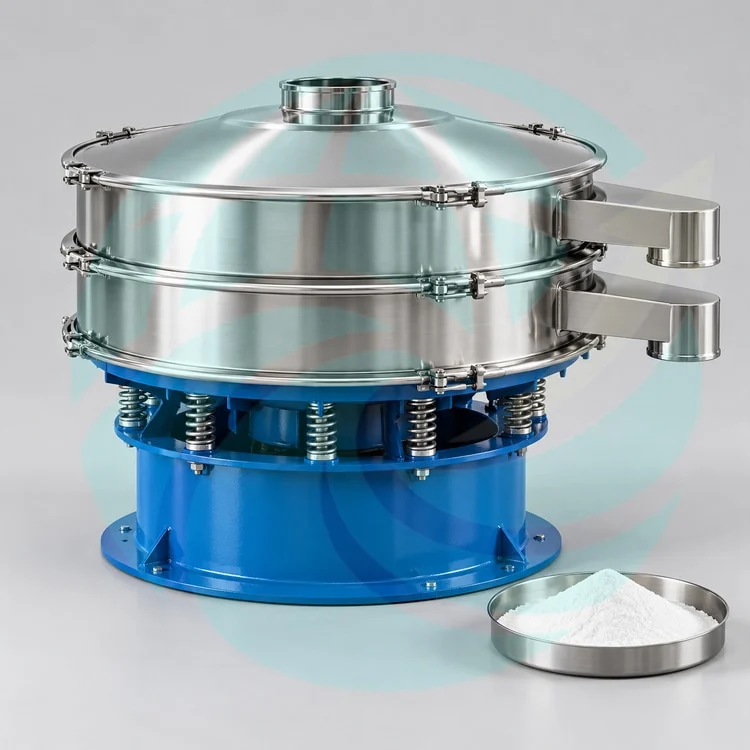
This guide explains how industrial buyers and process engineers can evaluate vibrating screening equipment, avoid common selection mistakes, and prepare the technical information needed for a meaningful supplier quotation.
1. What Should You Know Before Choosing a Vibrating Screen?
Before comparing screening machines, define what the equipment must accomplish in your production process.
A vibrating screen separates material primarily according to particle size. Its performance depends on how the material moves across the screen surface and whether appropriately sized particles can pass through the openings.
Define Your Screening Objective
Most industrial screening applications involve one or more of the following duties:
- Oversize removal: Separating particles or agglomerates larger than the required product size.
- Particle grading: Dividing a material into defined particle size fractions.
- Product protection screening: Removing unwanted oversized material before packaging or downstream processing.
- Process classification: Separating material before another manufacturing or processing stage.
- Fine-particle removal: Separating undersized particles from a product stream when the process requires it.
For example, screening flour to remove oversized agglomerates is a different duty from classifying crushed stone into several size fractions.
The equipment configuration, screen media, and operating conditions must match the intended separation.
Identify the Material and Its Processing Conditions
Begin by identifying the material accurately.
A general description such as “chemical powder” or “mineral granules” is useful, but insufficient for detailed equipment sizing.
Buyers should establish:
- Material name and composition, where relevant.
- Typical and maximum feed particle size.
- Particle size distribution, if available.
- Bulk density.
- Moisture condition.
- Flowability and tendency to form agglomerates.
- Abrasiveness, corrosiveness, or other special characteristics.
- Whether the process uses dry or wet screening.
Material conditions can change during storage, transport, and production. Where these changes are significant, the supplier should understand the expected operating range rather than one ideal sample condition.
Determine Your Target Particle Size and Required Capacity
Identify the separation result before selecting a screen opening.
For example, do you need to remove everything above a particular particle size, or produce two or more usable particle size fractions?
Also define the required feed rate in units such as kg/h or t/h, and specify whether this represents normal operation or a peak requirement.
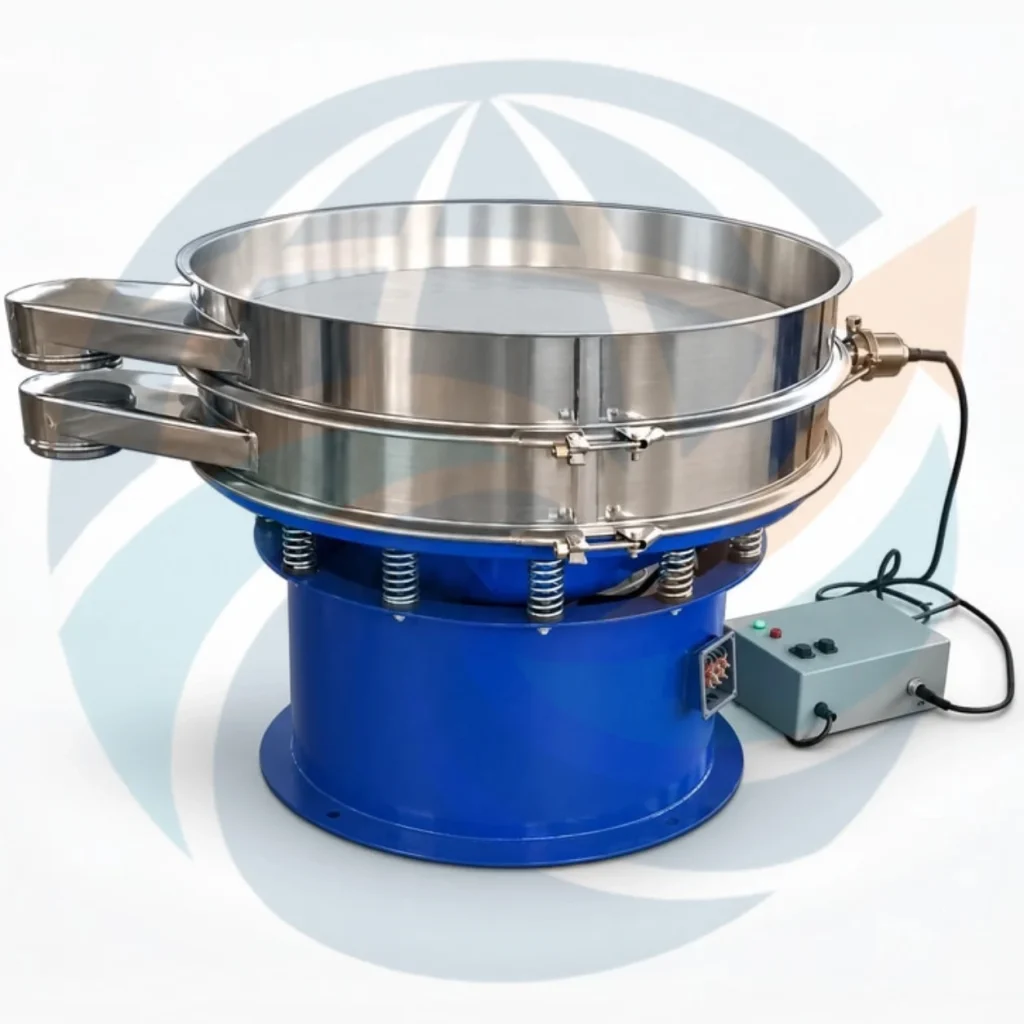
Capacity should not be selected from machine diameter or mesh size alone. A machine’s actual throughput depends on the material, screen configuration, feed conditions, and required separation quality.
Initial Vibrating Screen Selection Checklist
| Required Information | Questions to Answer |
|---|---|
| Material | What product will be screened? |
| Screening objective | Is the goal grading, oversize removal, or another separation? |
| Feed size | What is the particle size range entering the machine? |
| Target size | What separation size or final product specification is required? |
| Throughput | How much material must be processed per hour? |
| Moisture | Is the material dry, damp, sticky, or processed with water? |
| Bulk density | What is the approximate mass per unit bulk volume? |
| Product fractions | How many separate outputs are needed? |
| Processing conditions | Are there hygiene, corrosion, dust, or safety requirements? |
Completing this checklist before contacting suppliers makes the selection process more efficient and reduces the risk of comparing unsuitable machines.
2. How Do Material Properties Affect Vibrating Screen Selection?
Two materials with similar nominal particle sizes can behave very differently on the same screening equipment.
Understanding material behavior is essential because screening performance depends on more than the dimensions of the screen openings.
Particle Size Distribution and Bulk Density
Particle size distribution describes the proportions of different particle sizes in the feed.
This matters because material containing a high proportion of particles close to the target opening can be more difficult to separate.
These are often called near-size particles. They may require more opportunities to encounter and pass through the screen openings than particles much smaller than the aperture.
Bulk density also affects equipment selection.
For a given mass flow rate, materials with different bulk densities occupy different volumes. This changes the material loading and may affect feed arrangements and screen sizing.
When possible, provide a particle size distribution report and a measured bulk density rather than relying only on a general material name.
Moisture, Flowability, and Agglomeration
Moisture and poor flowability can make screening more difficult.
Damp or cohesive particles may stick together, adhere to the screen, or block openings.
Common screening problems include:
- Blinding: Fine material accumulates over screen openings and reduces the available screening area.
- Pegging: Particles become lodged in screen openings.
- Agglomeration: Fine particles form larger clusters that do not behave like individual particles.
- Uneven material distribution: Material accumulates in limited areas instead of spreading across the screening surface.
These issues can reduce throughput and affect separation quality.
For certain fine powders, ultrasonic-assisted screening may help reduce mesh blinding. However, ultrasonic vibration does not automatically solve severe moisture-related adhesion or all material flow problems.
Abrasiveness, Corrosion, and Hygiene Requirements
Material composition also influences the selection of screen media and product-contact components.
Abrasive minerals can accelerate wear. Corrosive chemicals may require suitable contact materials and additional protection. Food powders may introduce requirements for cleaning access, contamination prevention, and product-contact surfaces.
The correct material specification depends on the process.
For example, stainless steel construction alone does not establish that a machine meets a particular food-contact standard or is suitable for every corrosive chemical.
Similarly, combustible dust or hazardous processing conditions require a separate safety assessment.
Material Selection Considerations
| Material | Potential Screening Challenge | Key Selection Consideration |
|---|---|---|
| Flour | Agglomerates, dust, possible mesh blinding | Screen opening, cleaning, containment and hygiene |
| Starch | Fine particle behavior and possible cohesion | Flowability, mesh condition and screening assistance |
| Chemical pigments | Fine particles, adhesion and possible dust hazards | Material behavior, containment and safety requirements |
| Plastic granules | Particle grading and consistent discharge | Feed distribution, deck design and separation size |
| Silica sand | Abrasion and particle classification | Screen media wear, feed size and required capacity |
| Crushed stone | High loading, impact and abrasion | Heavy-duty machine suitability and screen media strength |
| Chemical granules | Variable particle size and possible corrosion | Contact materials, target size and handling conditions |
The table identifies engineering considerations, not guaranteed equipment performance for any specific material.
3. Which Type of Vibrating Screen Is Right for Your Application?
Different vibrating screen designs create different particle movements and material-handling conditions.
The most suitable type depends on the material, screening objective, installation constraints, and required processing duty.
Rotary Vibrating Screens for Powders and Granules
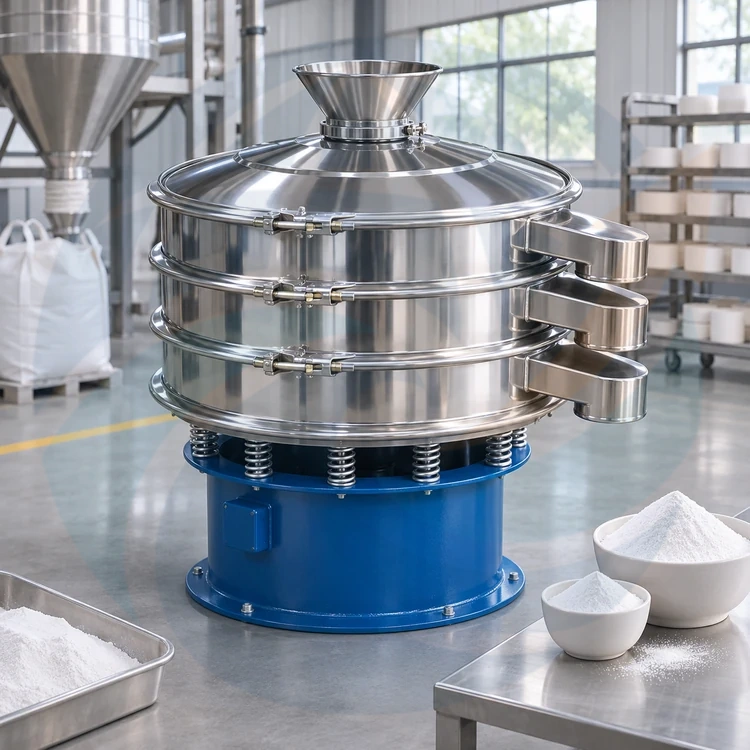
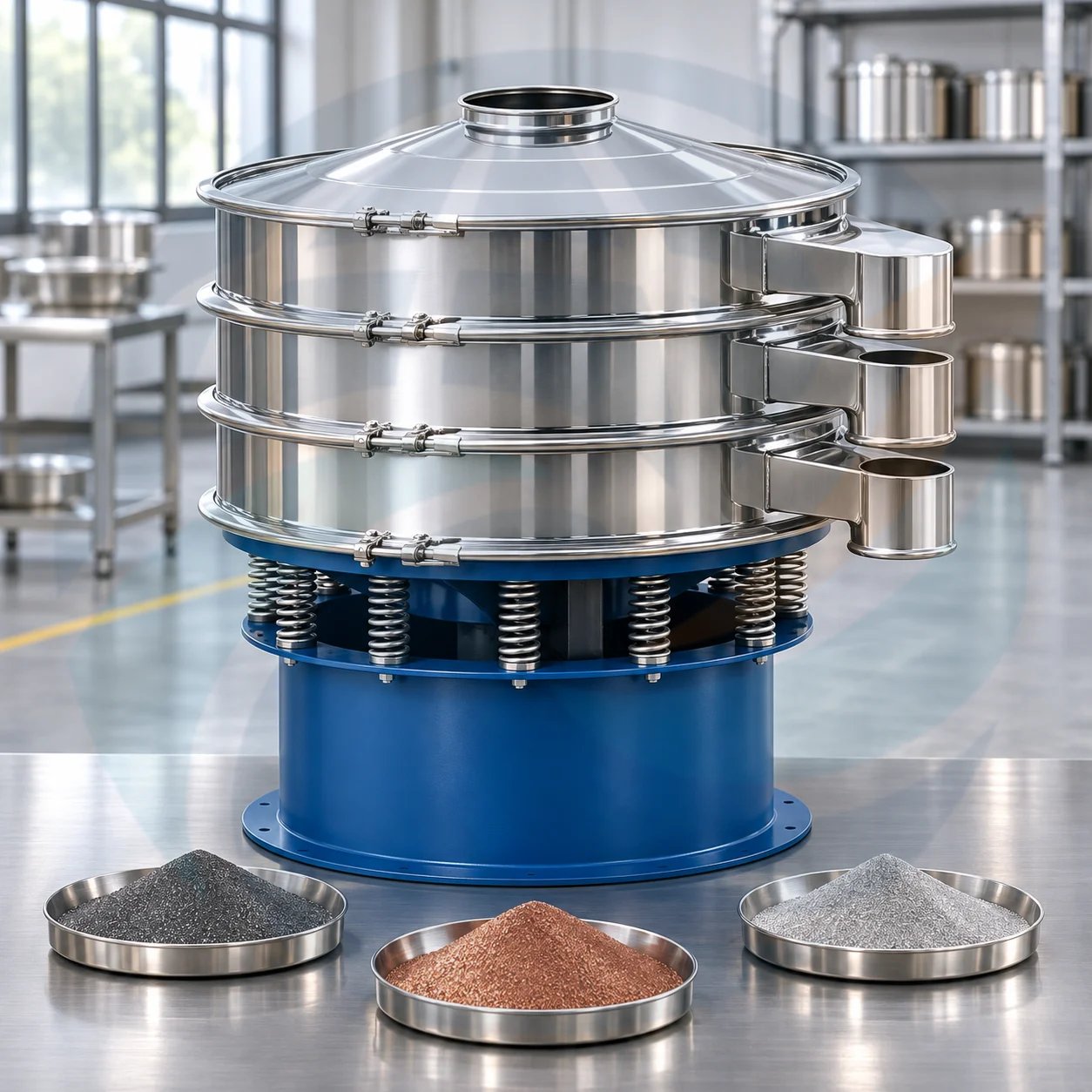
A rotary vibrating screen commonly uses a circular screening assembly and vibration generated by an eccentric motor arrangement.
The resulting motion distributes material across the screening surface, allowing appropriately sized particles to pass through the mesh while oversized material is discharged separately.
Rotary screens are often considered for suitable powder and granule screening applications, including grading and oversize removal.
Important selection factors include:
- Material flowability.
- Target screen opening.
- Required number of product fractions.
- Feed rate and loading conditions.
- Cleaning and screen replacement requirements.
- Inlet and outlet arrangements.
A rotary screen may be a suitable option for food or chemical powders, but its actual capacity and configuration must be reviewed against the specific material.
Linear Vibrating Screens for Material Classification
A linear vibrating screen uses predominantly linear vibration to move material along a screening deck.
This arrangement can be considered for suitable granular materials and industrial classification duties where directional movement is useful.
Potential applications include plastic granules, selected dry bulk materials, and certain mineral products.
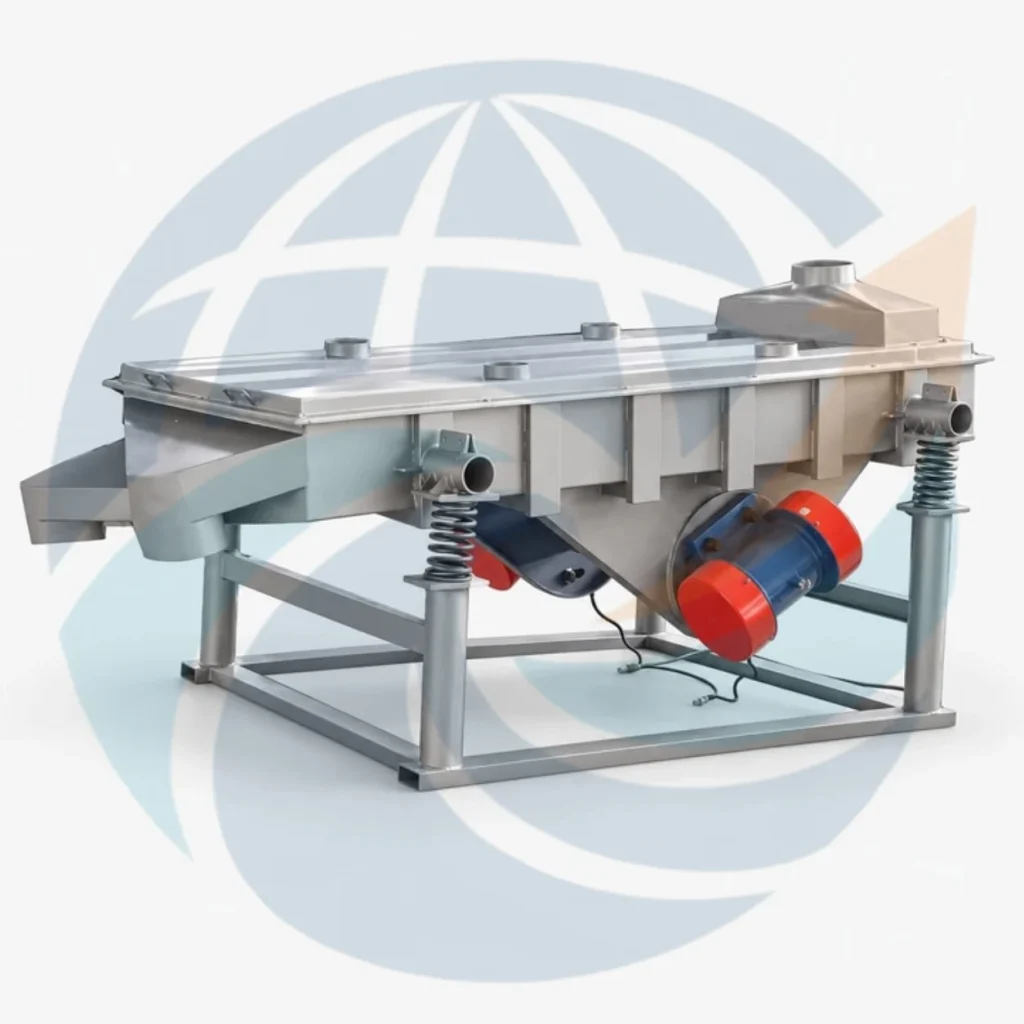
When evaluating a linear screen, buyers should consider feed distribution, particle size, deck dimensions, discharge positions, and material loading.
The construction required for a light-duty granular material application may be very different from that needed for abrasive aggregate processing.
Ultrasonic Vibrating Screens for Fine Powder Screening
An ultrasonic vibrating screen incorporates high-frequency vibration into the screen mesh system to assist certain fine-powder separation tasks.
Ultrasonic assistance is typically used together with an underlying screening machine. It should not be understood as a completely separate primary screening motion in every design.
This technology may be useful when fine powders produce persistent screen blinding under conventional vibration.
However, results depend on the material characteristics, screen media, equipment configuration, and operating conditions.
Where practical, difficult fine-powder applications should be evaluated using representative material samples.
When Heavy-Duty Mineral and Aggregate Screens Are Needed
Mining and aggregate operations may require specialized screening equipment designed for large feed volumes, high impact loads, abrasive materials, or demanding continuous-duty applications.
Depending on the process, suitable options may include heavy-duty inclined screens, horizontal screens, or other specialized configurations.
Do not assume that a standard powder screening machine or light-duty linear screen can replace a heavy-duty aggregate screen.
For these applications, machine sizing should consider feed gradation, throughput, wear, material moisture, and mechanical duty requirements.
Quick Equipment Comparison
| Screen Type | Typical Selection Situation | Important Limitation |
|---|---|---|
| Rotary vibrating screen | Suitable powder and granule grading, oversize removal | Performance depends on material and configuration |
| Linear vibrating screen | Directional material movement and classification | The design must match feed and operating duty |
| Ultrasonic-assisted screen | Certain fine powders with mesh blinding problems | Not effective for every sticky or cohesive material |
| Heavy-duty aggregate screen | Abrasive, high-load mineral and aggregate applications | Requires specific structural and process sizing |
For a more detailed explanation of machine motion and screening technology, read our Rotary vs. Linear vs. Ultrasonic Vibrating Screens comparison guide.
4. How Do You Select Screen Openings and Screening Capacity?
Screen opening size and processing capacity are closely related, but they are not interchangeable specifications.
A smaller opening does not automatically result in a better screening process, and a larger machine does not necessarily provide adequate capacity for every material.
Understanding Screen Opening Size and Required Separation
The screen opening determines which particles may physically pass through the screening surface.
Openings are commonly specified in millimeters or micrometers, depending on the application.
Mesh count is also used for certain woven screens, but mesh count alone can be ambiguous because aperture size depends on wire diameter and the applicable mesh standard.
For clear supplier communication, specify the required opening size and units whenever possible.
It is also important to distinguish between:
- Screen opening size.
- Actual particle size distribution.
- Required final product specification.
- Acceptable amount of misplaced material.
Real screening operations are not perfect separations. Particle shape, orientation, near-size particles, screen loading, and operating conditions influence the final result.
How Throughput and Feed Conditions Affect Screen Sizing
Required throughput is commonly expressed as mass processed per hour.
However, the machine’s capacity depends on multiple factors:
- Available screening area.
- Material bulk density.
- Feed particle size distribution.
- Target separation size.
- Moisture and flow behavior.
- Screen media type and open area.
- Number of screen decks.
- Feed distribution and operating settings.
- Required separation performance.
This is why screening capacity cannot be reliably calculated using only a machine diameter and nominal mesh size.
A supplier may need a detailed feed analysis before recommending an appropriate screen model.
When Material Testing or Manufacturer Review Is Necessary
Material testing is especially valuable when:
- The feed contains a large proportion of near-size particles.
- Fine powders show persistent blinding.
- Moisture or cohesion affects material movement.
- A strict separation quality is required.
- The application involves unusual material characteristics.
- The required processing capacity is critical to the production line.
If testing is offered by a supplier, confirm the test procedure, sample requirements, measured results, and limitations before relying on the outcome.
A material screening trial should represent the intended operating conditions as closely as practical.
5. How Does Screen Selection Differ by Industry?
The same screening principle can serve different industries, but the machine design and operating requirements may vary considerably.
Mining and Aggregate Screening
Mineral and aggregate screening often involves classifying sand, gravel, crushed stone, or other mineral feedstocks.
Major selection considerations include:
- Maximum feed size.
- Feed gradation.
- Required product size fractions.
- High or variable material loading.
- Abrasion and impact conditions.
- Wet or dry screening requirements.
- Maintenance access and screen media life.
A screen suitable for relatively fine dry sand may not be suitable for large crushed stone.
For heavy-duty applications, buyers should confirm that the proposed machine is designed and rated for the actual operating duty.
Food Powder Screening
Food powder screening may be used for flour, starch, sugar, and other suitable powdered ingredients.
The objective may be oversize removal, particle grading, or screening before another production stage.
Beyond screen opening size, buyers should consider cleanability, potential contamination, product-contact materials, dust containment, and access for inspection.
A rotary vibrating screen may be an option for suitable powder screening duties.
For fine materials that experience mesh blinding, an ultrasonic-assisted arrangement may also deserve evaluation.
Equipment compliance with specific food safety regulations must be verified rather than inferred from appearance or material descriptions.
Chemical Powder Screening
Chemical powders vary widely in their physical and chemical properties.
Pigments, additives, resins, and other powdered materials can have different levels of cohesion, abrasiveness, moisture sensitivity, and flowability.
Some fine powders may benefit from ultrasonic assistance when screen blinding is a concern.
However, equipment selection must also consider the chemical compatibility of contact components and the process environment.
Where dust is combustible or a material presents other hazards, appropriate risk assessment and compliant equipment selection are essential.
Plastic Granule and Industrial Bulk Material Screening
Plastic pellets and other suitable granules may require size classification or removal of oversized particles.
A linear vibrating screen may be considered when the process benefits from directional movement across the screening deck.
A rotary design may also be appropriate for certain grading or oversize-removal duties.
Selection should be based on the required separation, feed characteristics, available installation space, and actual machine capability.
6. What Should You Check Before Purchasing a Vibrating Screen?
Selecting the general screen type is only the first part of the purchasing process.
Before placing an order, buyers should review installation, operation, maintenance, and supply arrangements.
Installation Space, Inlets, and Outlets
Confirm that the equipment can fit into the intended production area and connect with upstream and downstream machinery.
Important details include machine dimensions, maintenance clearances, feed inlet position, discharge outlet arrangement, and supporting structure.
Where the screen is part of an existing line, provide a layout drawing or photographs showing the available space.
Cleaning, Wear Parts, and Maintenance Access
Screening equipment contains components that may require periodic inspection, cleaning, or replacement.
These may include screen mesh, seals, clamps, springs, bearings, and vibration-related components, depending on machine design.
Ask how the selected machine is opened, cleaned, inspected, and serviced.
For abrasive materials, consider wear protection and screen media replacement requirements.
For food or chemical powders, cleaning access and cross-contamination risks may be particularly important.
Electrical Requirements and Equipment Documentation
Before ordering, confirm the intended electrical supply, motor configuration, control arrangements, and relevant protection requirements.
The supplier should also clarify which drawings, operating instructions, and electrical documents will be provided with the equipment.
If the machine will operate in a regulated or hazardous environment, identify those requirements during quotation—not after the equipment has been manufactured.
Supply Scope, Spare Parts, and Delivery Terms
A complete quotation should make clear what is included and what is excluded.
Confirm:
- The screening machine and agreed configuration.
- Included screen media and accessories.
- Motor and control equipment, where applicable.
- Documentation and drawings.
- Recommended spare parts and their availability.
- Packaging and shipping arrangements.
- Applicable commercial terms.
- Inspection or testing requirements, if agreed.
These details are especially relevant to international B2B purchases, where misunderstandings about supply scope can create installation delays and additional costs.
7. How to Request a Vibrating Screen Quotation
A useful vibrating screen quotation should be based on the actual material and processing requirements.
Instead of asking only for a machine price, provide the technical information that allows the supplier to evaluate your application.
Essential Technical Information for an RFQ
Use the following inquiry format:
Material Information
- Material name:
- Material composition or special characteristics:
- Feed particle size range:
- Particle size distribution, if available:
- Bulk density:
- Moisture condition:
- Flowability or known handling problems:
Screening Requirements
- Screening objective:
- Target screen opening or product specification:
- Required number of size fractions:
- Required throughput (kg/h or t/h):
- Operating hours per day:
- Acceptable separation quality or product tolerance:
Equipment and Installation Requirements
- Available installation space:
- Electrical supply:
- Inlet and outlet requirements:
- Cleaning and maintenance requirements:
- Dust containment or other process requirements:
- Destination country:
- Expected delivery schedule:
If exact values are unavailable, identify the unknown items clearly and provide available photographs, drawings, or material samples.
Questions to Ask the Screening Equipment Supplier
Before comparing quotations, ask:
- What equipment type and configuration do you recommend for this material?
- What feed conditions and performance assumptions does the recommendation use?
- Which material characteristics could reduce throughput or separation quality?
- What screen media and contact materials are proposed?
- How many screening decks and discharge outlets are included?
- What electrical and installation requirements apply?
- Which spare parts and technical documents are supplied?
- Can representative material testing or a technical review be arranged?
- What is included in the quoted price and delivery scope?
Comparing suppliers based on these answers provides more useful information than comparing nominal machine size or price alone.
For available equipment categories, explore our industrial vibrating screens or contact HaoYuan to discuss your application requirements.
8. Frequently Asked Questions About Vibrating Screen Selection
What is the difference between a vibrating screen and a vibratory screener?
Both terms describe equipment that uses vibration to assist particle separation. “Vibrating screen” is common in aggregate, mineral, and industrial screening, while “vibratory screener” is also frequently used for powder and process equipment. Actual machine configurations vary, so the name alone does not establish suitability.
Which vibrating screen is suitable for fine powders?
Rotary vibrating screens are commonly considered for suitable powder screening duties. Ultrasonic-assisted screening may help when certain fine powders cause mesh blinding. The best option depends on particle characteristics, flowability, target size, and required throughput.
How do I select the correct screening mesh?
Start with the required separation size and particle size distribution. Specify the opening in millimeters or micrometers where possible, and identify the relevant standard if using mesh count. Screen media and final selection should be reviewed against the actual material and processing conditions.
Can one vibrating screen produce multiple particle size fractions?
Yes, suitable multi-deck vibrating screen configurations can separate material into more than two size fractions. The number of outputs depends on the deck arrangement, screen openings, material, and equipment design.
What information determines vibrating screen capacity?
Important factors include feed particle size distribution, bulk density, moisture, flowability, screen opening, screening area, screen media, number of decks, and required separation performance. Capacity should be evaluated for the actual application rather than inferred from a single machine dimension.
Is ultrasonic screening always better than conventional vibrating screening?
No. Ultrasonic screening can provide benefits for certain fine-powder applications, particularly when mesh blinding is a problem. It introduces additional equipment considerations and may not be necessary or effective for every material.
Can the same vibrating screen process both sand and food powder?
Not necessarily. Sand and food powders can require very different machine construction, screen media, cleaning arrangements, and operating conditions. Suitability must be evaluated for each material and application.
Conclusion: Match the Vibrating Screen to Your Material and Screening Objective
Choosing the right vibrating screen requires a clear understanding of the material, the required separation result, and the production environment.
Begin with the particle size distribution, moisture condition, bulk density, flowability, and processing capacity. Then evaluate the appropriate screening motion, screen media, number of decks, and installation requirements.
Rotary, linear, ultrasonic-assisted, and heavy-duty screening systems each have roles in industrial processing, but no single design is suitable for every material.
A technically complete inquiry helps suppliers recommend a more appropriate equipment configuration and reduces the risk of selecting a machine based on incomplete information.
Need help selecting a vibrating screen for your application?
HaoYuan supplies industrial screening and material handling equipment for suitable powder, granule, and bulk material processes.
Explore our vibrating screen equipment range or send us your material and screening requirements to discuss available options and request a quotation.
 English
 French
 German
 Indonesian
 Korean
 Malay
 Japanese